Climate
AlUla has a hot desert climate, typical of much of Saudi Arabia: very hot summers, mild winters, extremely low humidity and very little rain.
Northwestern Saudi Arabia
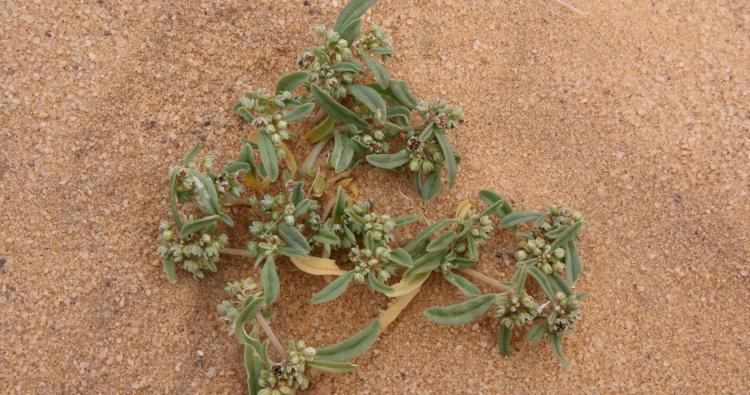
Species of the Day
Gisekia pharnaceoides L.
AlUla County, located in northwestern Saudi Arabia, is a hyper-arid region typically characterized by hot summers and low annual rainfall. The region’s landscapes reflect a geological history spanning over a billion years, ranging from ancient Precambrian rocks to sandstone formations and volcanic terrain.
The Region
AlUla County, in northwestern Saudi Arabia, is a hyper-arid land where nearly one billion years of geology lie exposed: ancient mountains, carved sandstones, sand plains and dunes, and vast basalt lava fields. These contrasting landscapes shape the habitats and the plants that survive in them.
AlUla has a hot desert climate, typical of much of Saudi Arabia: very hot summers, mild winters, extremely low humidity and very little rain.
AlUla's landscape records a geological history spanning nearly one billion years, with a great variety of igneous, metamorphic and sedimentary rocks exposed over a relatively small area.
AlUla lies within the deserts and xeric shrublands biome, at the meeting point of several ecoregions, and roughly midway between two global biodiversity hotspots: the Mediterranean basin and the Horn of Africa.
Overgrazing, woodcutting, off-road driving and climate change put growing pressure on AlUla's fragile desert habitats, which can take decades to recover.
Habitats
These diverse systems support a rich variety of plant life, with 460 recorded vascular plant taxa, of which 250 are represented here. This botanical heritage includes species endemic to Saudi Arabia and the Arabian Peninsula, as well as species with ranges restricted to northwestern Saudi Arabia and neighboring countries. The region is also home to various bryophytes and lichens.
Although AlUla possesses significant phytodiversity, many species have not yet been fully assessed; some are classified as "Data Deficient." Continued research and conservation efforts are therefore crucial to understanding and protecting the habitats and flora characteristic of the area. (see Abdulkareem et al., 2026)
About Us
This web application provides an online database about the Flora of AlUla. It is accessible for experts, local communities, students, tourists and nature lovers.
250 species are featured in the database, with more to come! Here you will also be able to: