Habitats › Sandy Plains and Dunes
Habitat Group
Sandy Plains and Dunes
- 3 habitats
- 123 species recorded
The sandy plains and dunes habitats encompasses the extensive sand-dominated landscapes of eastern AlUla, along with smaller patches distributed across the wider county. These deposits originate from a mix of geomorphological processes and long-distance aeolian transport. Surface stability varies widely: sandy plains typically form gently undulating, semi-stable terrain, while deeper accumulations develop where sand becomes trapped against natural barriers such as sandstone buttes, wadi margins, or topographic features.
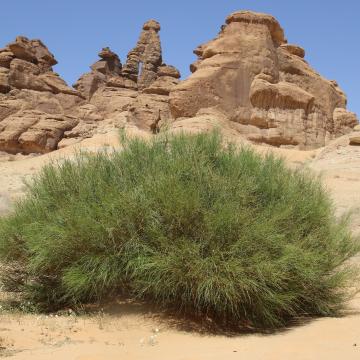
Vegetation structure reflects this variability. Sandy plains commonly support open dwarf shrubland dominated by drought-tolerant shrubs and grasses, while deeper or more mobile sands support more specialised dune vegetation, including open shrubland and, in some areas, very open Haloxylon persicum woodland. These habitats form a key ecological matrix linking sandstone landforms, wadis, and gravel plains, supporting flora and fauna characteristic of sandy desert systems.
Characteristic Species
All species in Sandy Plains and Dunes →

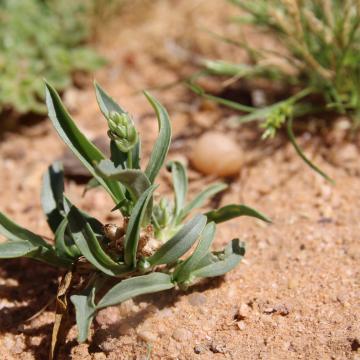

Sandy Plains
Sandy plains are open, low-relief landscapes dominated by sand-rich substrates. They range from extensive areas of almost pure sand to mixed sandy-gravel plains where sand remains the dominant surface material. The substrate is typically composed of fine, well-sorted sand, although larger rounded pebbles may occur locally.
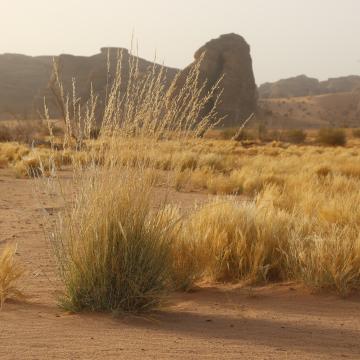
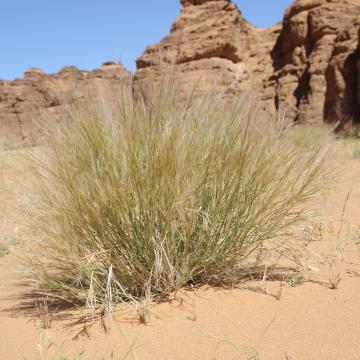
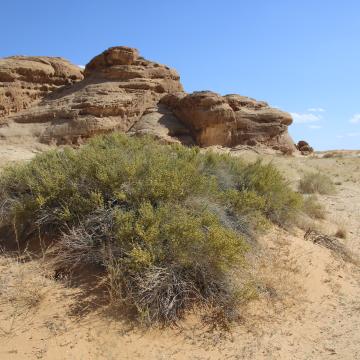
Open dwarf shrubland characteristically dominated by Haloxylon salicornicum with a herb layer (desert grassland) typically dominated by the grasses Stipagrostis plumosa and Stipagrostis obtusa. In areas, Ephedra alata and or Retama raetam become codominant with Haloxylon salicornicum often forming large nabkha.
In places, such as nabkha, where there is deeper sand, a desert herb community commonly with Artemisia monosperma, Polycarpaea repens, Centropodia forskaolii, and Convolvulus cephalopodus subsp. bushiricus develops becoming transitional with the deep sand dune community (3300).
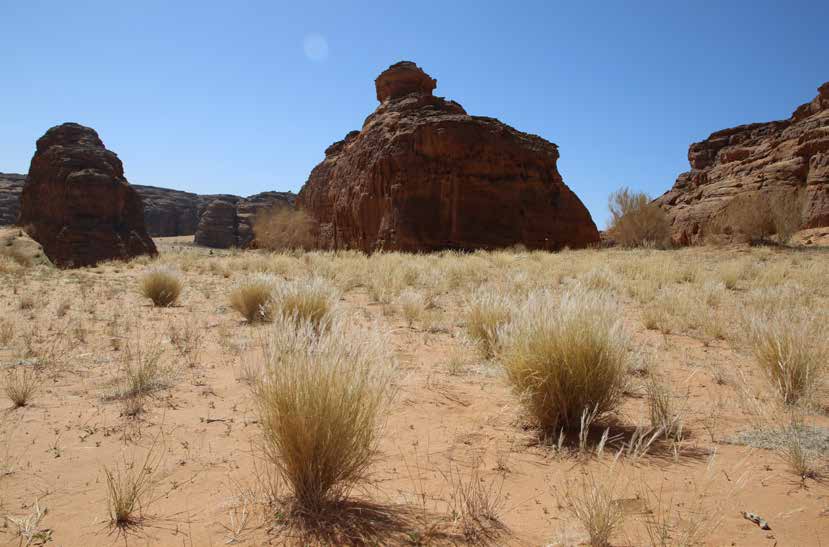
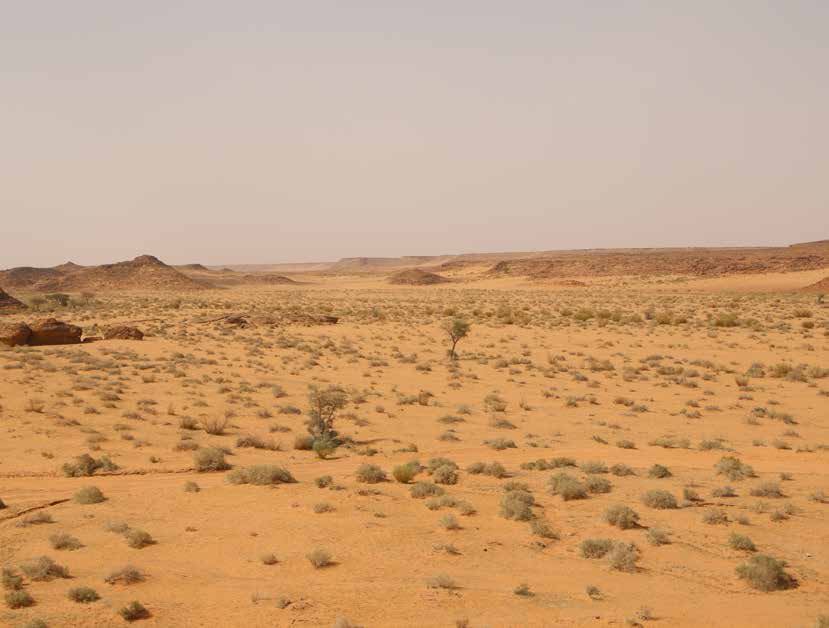
Sand Sheets with Exposed Bedrock
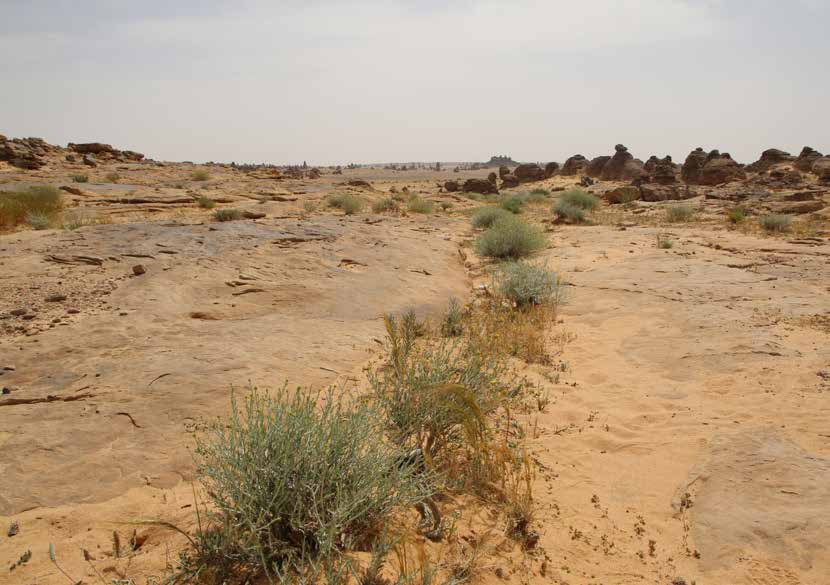
Thin, discontinuous sandsheets overlie a low-relief sandstone bedrock platform, with frequent areas of exposed rock.
Very sparse dwarf shrubland.
Characteristically dominated by Rhanterium epapposum with associated species such as Fagonia glutinosa, Astragalus spinosus and Helianthemum lippii with Retama raetam in sandy runnels. The density of this dwarf shrubland is variable but is generally very sparse due to overgrazing.
Local variation in the vegetation composition occurs depending on sand depth, bedrock topography, and proximity to other dune or rocky habitats, producing a mosaic of sandy patches, bare rock, and vegetated microsites.
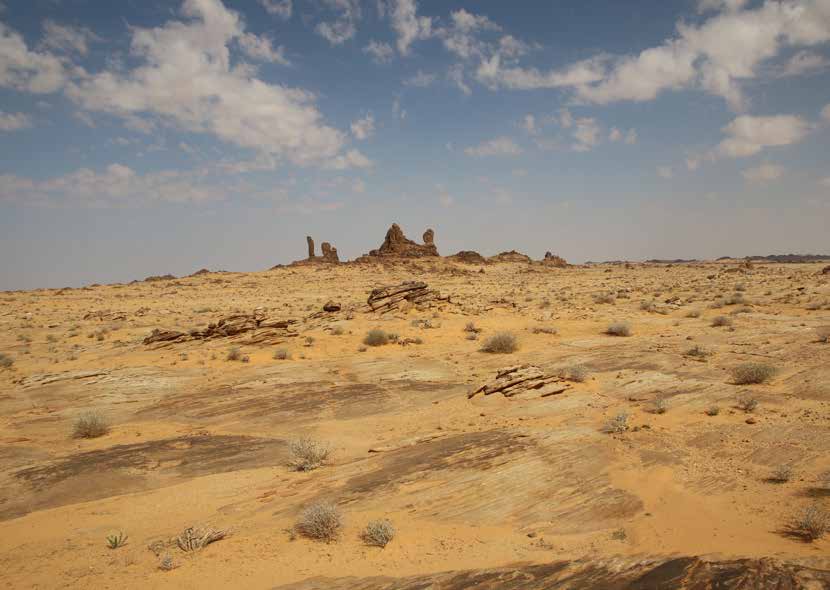
Sand Dunes
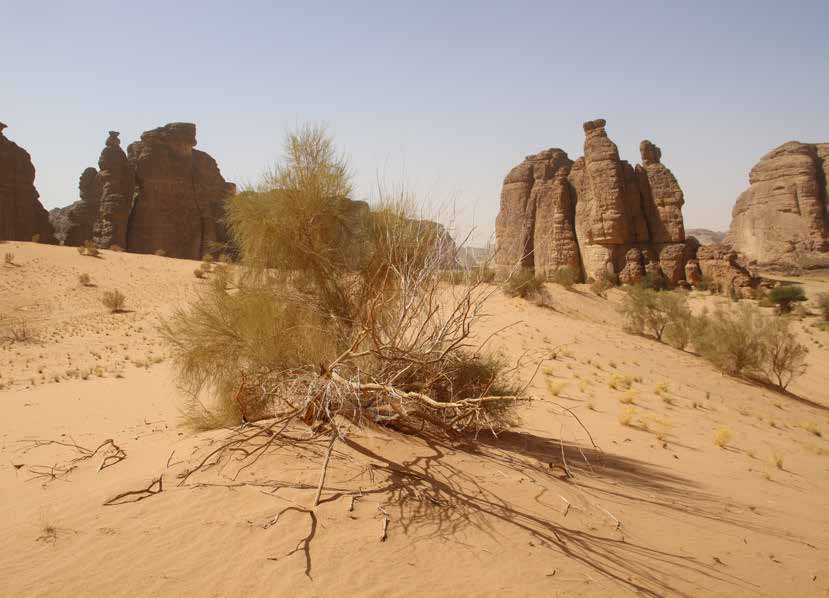
Mounds or ridge-like accumulations formed by aeolian deposition of loose sand. Often where sustained wind deposition has built up thick bodies of sand against rock outcrops or natural topographic barriers. For the purposes of this classification this habitat type also includes areas of deep sand.
Variable in density and composition ranging from unvegetated to open woodland depending on local factors including water availability, recent rainfall and dune stability.
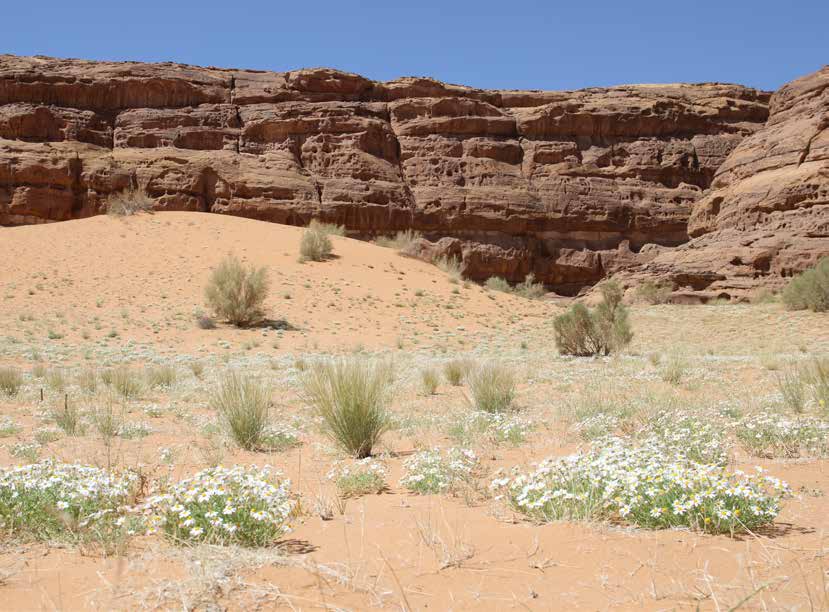
Many dunes support only ephemeral annual vegetation following rainfall, with species such as Anthemis desertii, Silene arabica, Monsonia nivea, and Neurada procumbens appearing rapidly. Where dunes are more stable a characteristic open dwarf shrubland can develop including species such as Centropodia forskaolii, Moltkiopsis ciliata, Convolvulus cephalopodus subsp. bushiricus. In some areas, particularly on larger or more stable dune systems where there is deep ground water, Haloxylon persicum can form an open woodland.
Adapted from The Habitats of AlUla – Technical Manual (AFALULA, 2026).