Habitats › Mountains and Associated Plains
Habitat Group
Mountains and Associated Plains
- 4 habitats
- 1 micro-habitat
- 77 species recorded
The Mountains and associated plains comprise the Hijaz mountain systems of AlUla and their adjoining foothill and gravel plain environments. It spans a broad altitudinal gradient from rugged upland summits and steep slopes to lower foothills and depositional lowland plains.
The mountain landscapes are formed predominantly from Precambrian crystalline rocks of the Arabian Shield, creating rugged, dissected terrain with extensive areas of exposed bedrock and shallow soils. In contrast, the associated plains are composed of gravel and alluvial deposits derived from long-term erosion and downslope transport of mountain material.
Vegetation structure transitions from montane shrublands at high altitude to open Vachellia woodlands and perennial grasslands on foothills and plains.
High-altitude areas form a distinct ecological zone within AlUla, functioning as climatic and topographic refugia. These areas support a distinct flora and fauna with a higher proportion of range-restricted and conservation-significant species compared to the surrounding lower altitude areas. In addition to supporting a high proportion of range-restricted vascular plants and fauna, they also provide important refugial habitat for bryophytes and other cryptogams.
Characteristic Species
All species in Mountains and Associated Plains →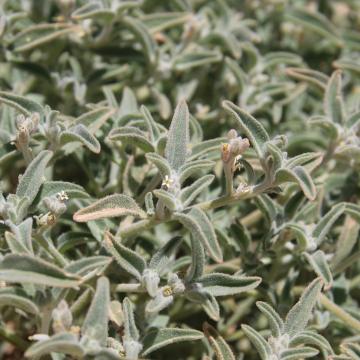
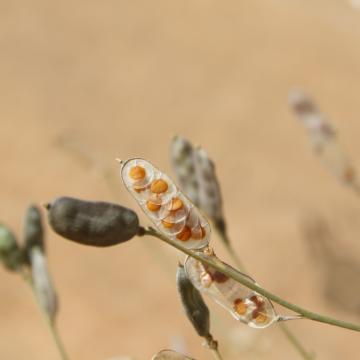
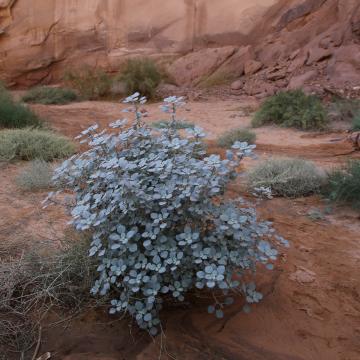
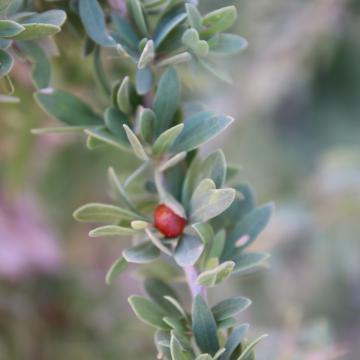


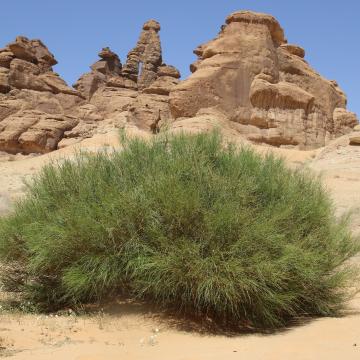
High-Altitude Mountains
Mountainous uplands with summits, ridges and structural plateaus. Terrain ranges from gently sloping, to steep cliffs and convex summit areas. From around 1500m to the highest summit areas of Jabal AlWard (2096m) including associated runnels and gullies. Cooler and comparatively moister conditions support a distinct assemblage of plant and animal species, including endemic species and others of particular conservation significance.
High-altitude areas function as important refugia for cryptogams. Cooler temperatures, enhanced moisture availability and the presence of shaded cliffs, rock crevices and sheltered runnels support a distinctive bryophyte flora, including Clevea spathysii, Molendoa handelii and Syntrichia rigescens (Hugonnot et al., 2025b). These upland environments also provide favourable conditions for lichen communities, with Jabal AlWard identified as a particularly important area for future survey owing to its higher moisture availability and abundance of sheltered microhabitats (Marques et al., 2025).
Open shrubland characteristically dominated by Retama raetam and Artemisia sieberi. In some surveyed summit areas, the Saudi Arabian endemic Euryops jaberiana becomes codominant.
This is associated with a diverse mixed shrubland of dwarf shrubs such as Ballota undulata, Teucrium polium, Astragalus spinosus, Ferula sinaica, Tanacetum sinaicum and Stachys aegyptiaca. Trees such as Pistacia khinjuk, Sageretia thea and other species such as Nepeta sheilae, and Umbilicus horizontalis are found in more sheltered areas.
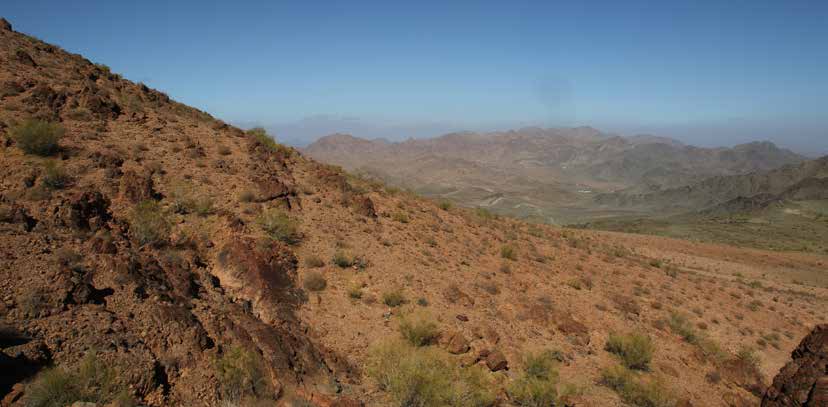
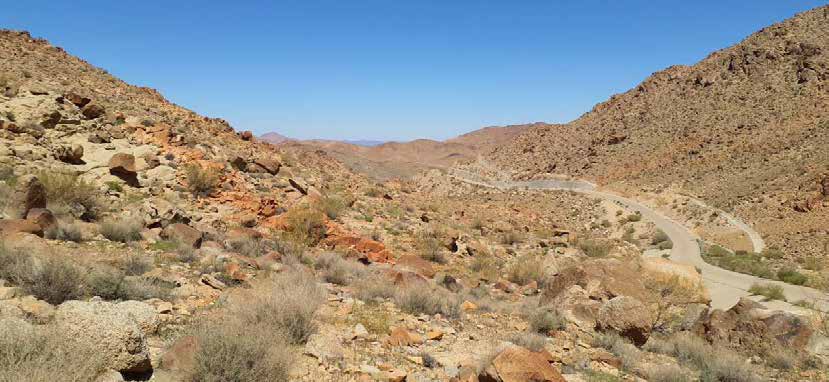
Mid-Altitude Mountains
Rocky mountain uplands of the Hijaz mountain area between about 1200 and 1500m with associated runnels and upper wadi systems. Mid-altitude mountains represent the transition between arid foothill systems and cooler high-altitude massifs.
Low montane shrubland.
Slopes are typically dominated by species such as Helianthemum lippii and Gymnocarpos decander with Centaurea pseudosinaica and Fagonia mollis. A characteristic Retama raetam and Zilla spinosa shrubland is found in areas of the west of AlUla with Retama raetam rare and concentrated in wadis and runnels at lower altitudes becoming more frequent at higher altitude.
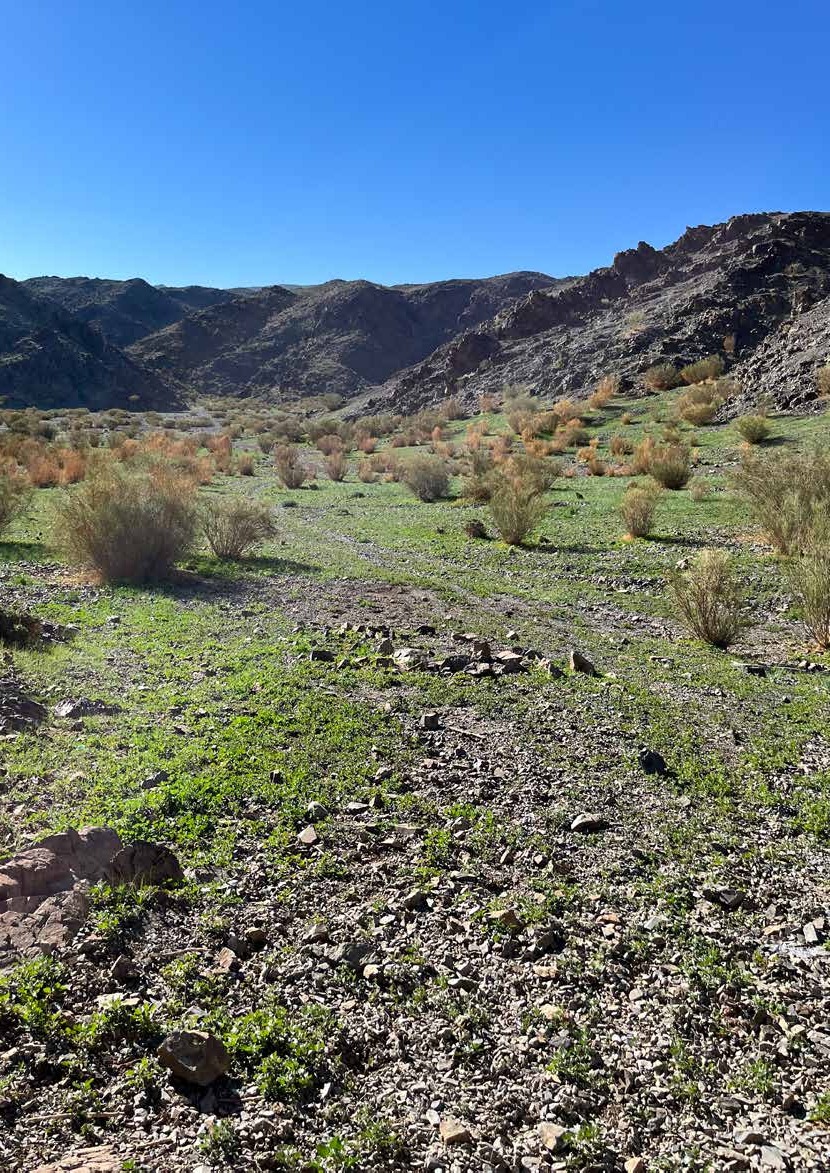
In the runnels and wadis the vegetation becomes denser and is typically characterised by Lycium shawii and Ephedra ciliata shrubland with an associated mixed montane shrubs including Blepharis ciliaris, Ochradenus baccatus, Gypsophila capillaris, Lavandula coronopifolia, Gymnocarpos decander, Helianthemum lippii. Species such as Teucrium polium and Otostegia fruticosa found in wadis at higher altitudes and Vachellia tortilis subsp. tortilis woodland at lower altitudes.
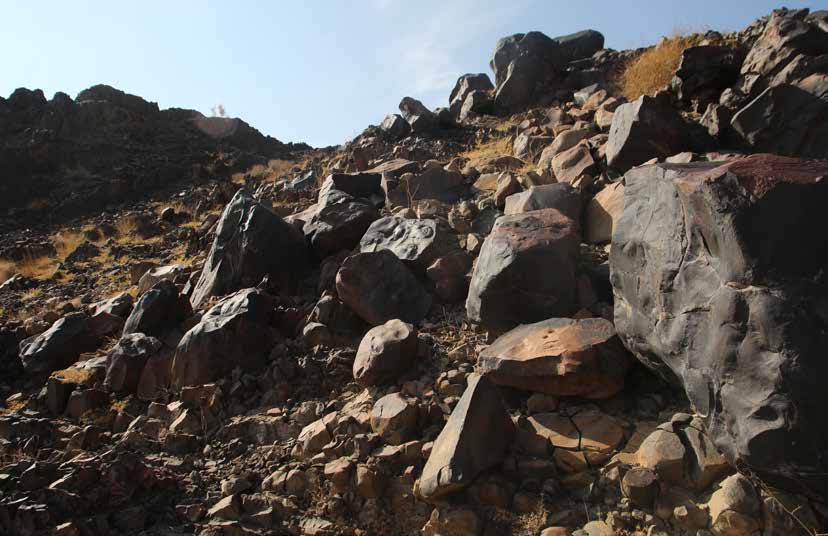
Low-Altitude Mountains
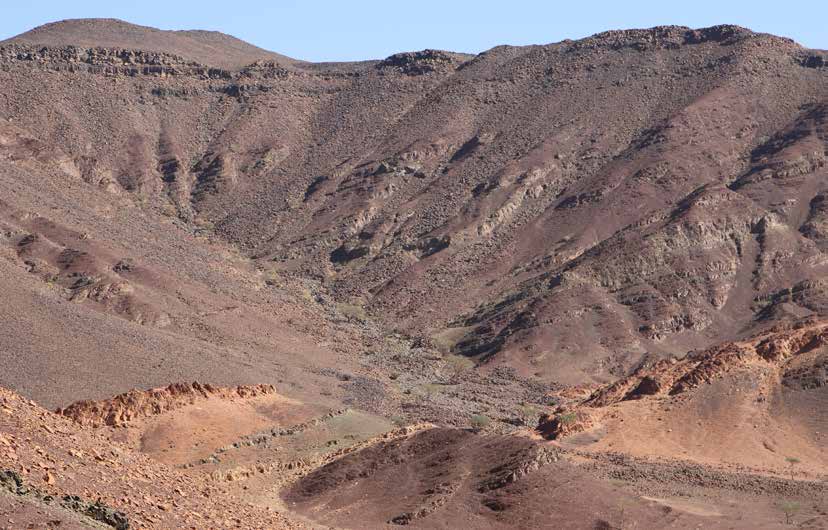
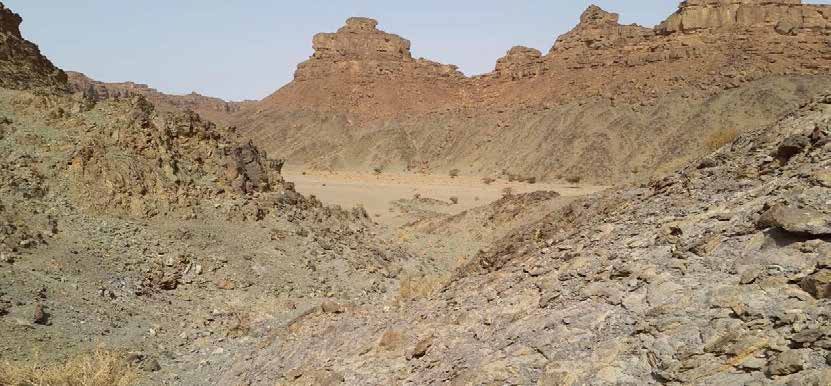
Lower slopes and foothills of the Hijaz Mountains, extending from approximately 1200 m down to surrounding plains and major wadi systems. The terrain is rugged and irregular, characterised by rocky slopes with associated runnels and gullies, screes and locally steep rock faces transitioning downslope into gentler terrain.
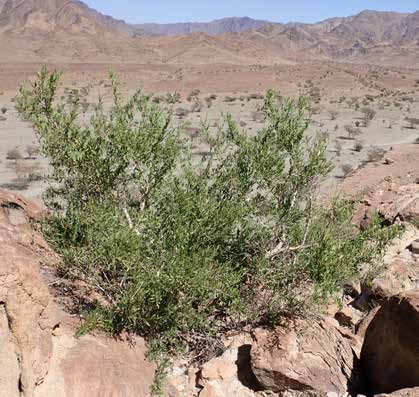
Very sparse montane herb community with scattered shrubs and trees in drainage channels and wadis.
Many low-altitude slopes are bare of vegetation apart from a flush of grassland that develops after rains and is dominated by Stipagrostis spp. In some areas a very sparse montane herb community is typically dominated by species such as Fagonia bruguieri, Forsskaolea tenacissima and Tetraena simplex with scattered Lycium shawii and shrub-like Vachellia spp. in drainage channels.
In more sheltered areas a very sparse drought deciduous mixed woodland is still seen that varies in composition but includes Vachellia tortilis subsp. tortilis, Moringa peregrina, Senegalia hamulosa, Commiphora gileadensis, Vachellia tortilis subsp. raddiana with an understory shrubland of Lycium shawii, Lavandula coronopifolia, Ochradenus baccatus, Hibiscus micranthus. This woodland, now largely restricted to sheltered wadis and rocky refugia, would have been much more widespread over these slopes in the past, but trees have been cut for fuel and building material.
Gravel Plains
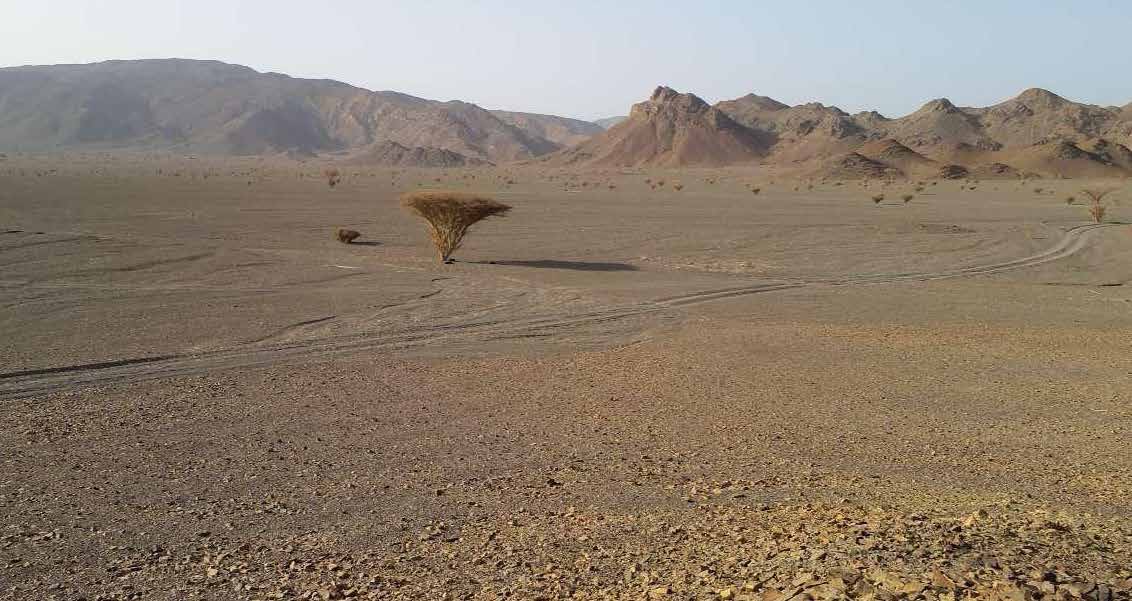
Plains and low slopes of the Hijaz mountains area covered in loose gravel and rocks.
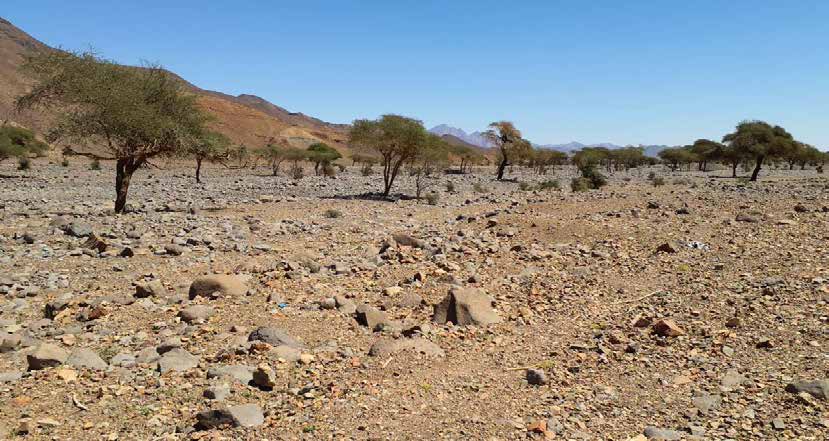
Gravel plains comprise gently undulating to locally sloping surfaces characterised by a covering of loose gravel, stones, and coarse clasts. These plains occur at the base of mountain systems and across intermontane areas and intermediate between rocky mountain slopes and sandy plains.
Vegetation is variable depending on factors such as degradation.
It ranges from very open Vachellia tortilis subsp. raddiana and Vachellia tortilis subsp. tortilis woodland with an understory of Haloxylon salicornicum, Ochradenus baccatus, Panicum turgidum and Lycium shawii through to a sparse shrubland of Vachellia spp. with very occasional Haloxylon salicornicum eventually becoming denuded plains.
Mountain Springs and Pools micro-habitat
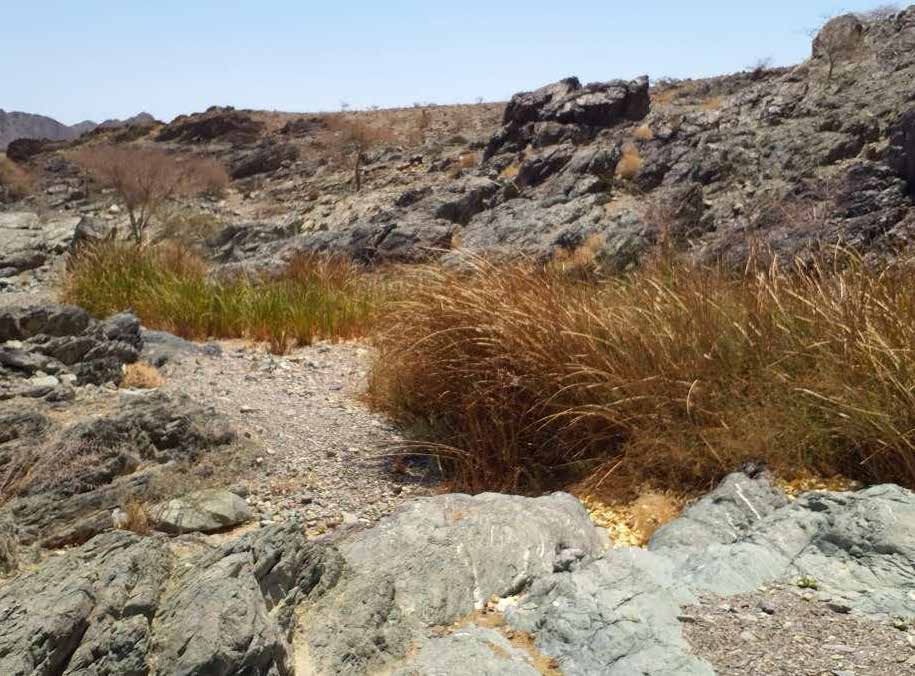
Where groundwater emerges naturally at the surface producing visible flowing water, persistent wet ground, or localised pooling. Springs support distinctive vegetation that differs markedly from surrounding dry habitats. This may include dense shrub or tree growth, hygrophilous herbs, reeds, or ferns, reflecting consistently elevated moisture availability. As a result, springs function as important ecological focal points, providing water, shade, and foraging resources for a wide range of fauna and acting as long-term refugia within otherwise arid environments.
Adapted from The Habitats of AlUla – Technical Manual (AFALULA, 2026).