Habitats › Sandstone Landforms
Habitat Group
Sandstone Landforms
- 3 habitats
- 1 micro-habitat
- 126 species recorded
Sandstone landforms comprise extensive sandstone plateaus, inselbergs, buttes, mesas, cliffs, and associated slopes that dominate large parts of eastern and northeastern AlUla. These landscapes are defined by exposed sandstone bedrock shaped by long-term erosion, resulting in a strongly dissected terrain of high relief and distinctive rock forms.
In central AlUla, the dominant bedrock is the Siq Sandstone, which is very well cemented, red due to high iron content, and heavily fractured. These are hard blocky sandstones creating large ridges, or mesa. In central AlUla and moving towards the north, the lighter, Quweria Sandstone is exposed creating a mixture of sandstone formations and sandy plains and dunes. The Saq Sandstone lies to the north and north east, with hard iron beds exposed, interspersed with pebble gravel plains and accumulations of fine sandy plains.
Sandstone landforms provide the physical framework for a range of associated habitats, including outcrops, boulder slopes, screes, and canyons. Shallow soils and variable exposure lead to patchy vegetation cover, while shaded cliffs, ledges, and sheltered slopes form important refugia for specialised and locally restricted species. Collectively, these landforms constitute a key structural component of the AlUla landscape, contributing strongly to its ecological diversity, visual character, and natural and cultural heritage.
Characteristic Species
All species in Sandstone Landforms →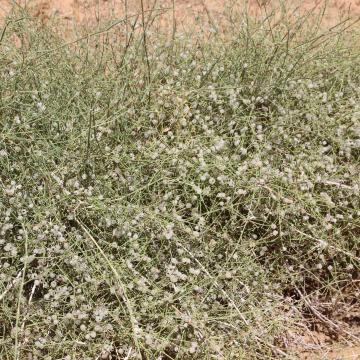




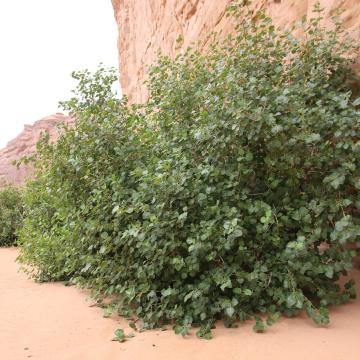

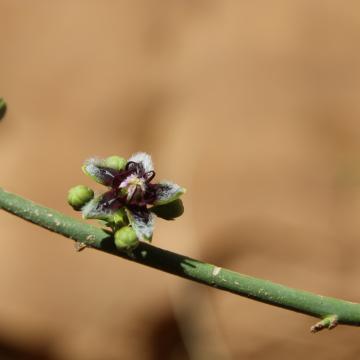
Sandstone Outcrops
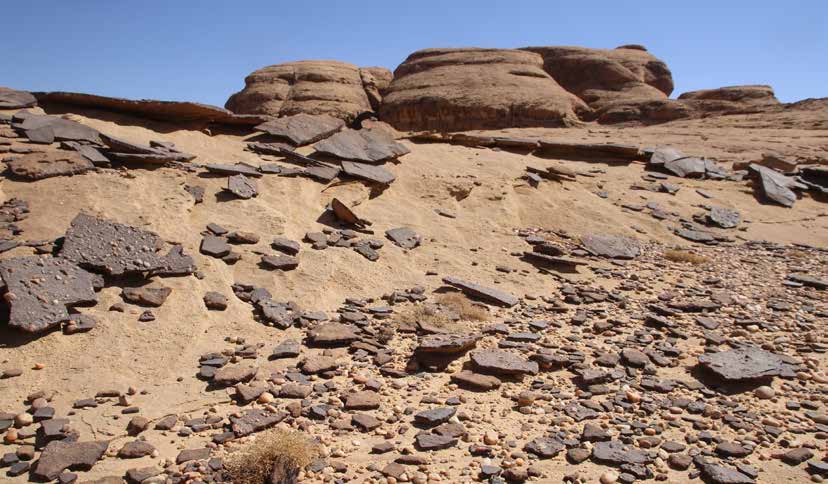
Sandstone bedrock and loose shale and gravel pavements of the summits of inselbergs, buttes, mesa, and sandstone hills.
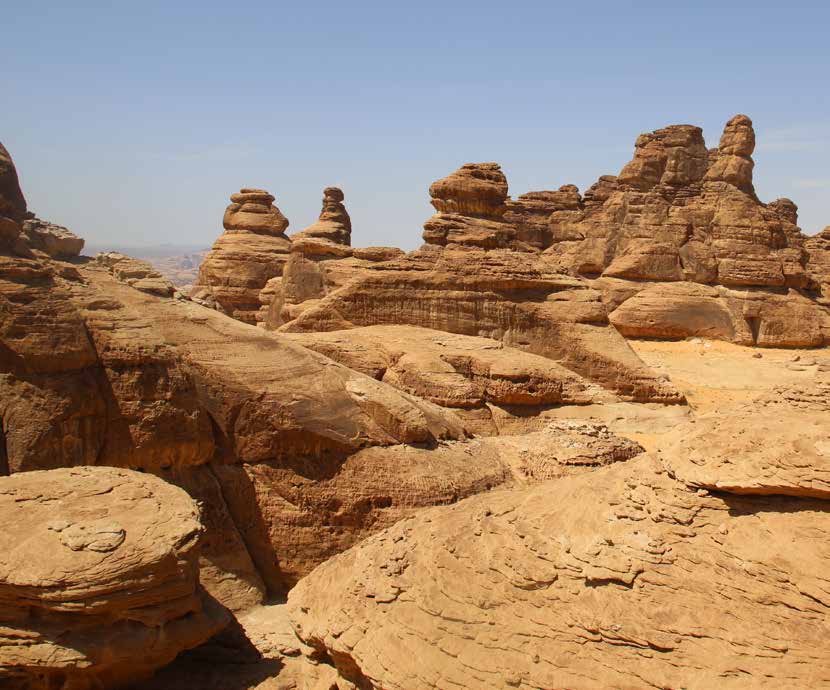
Sandstone Boulder Slopes and Screes
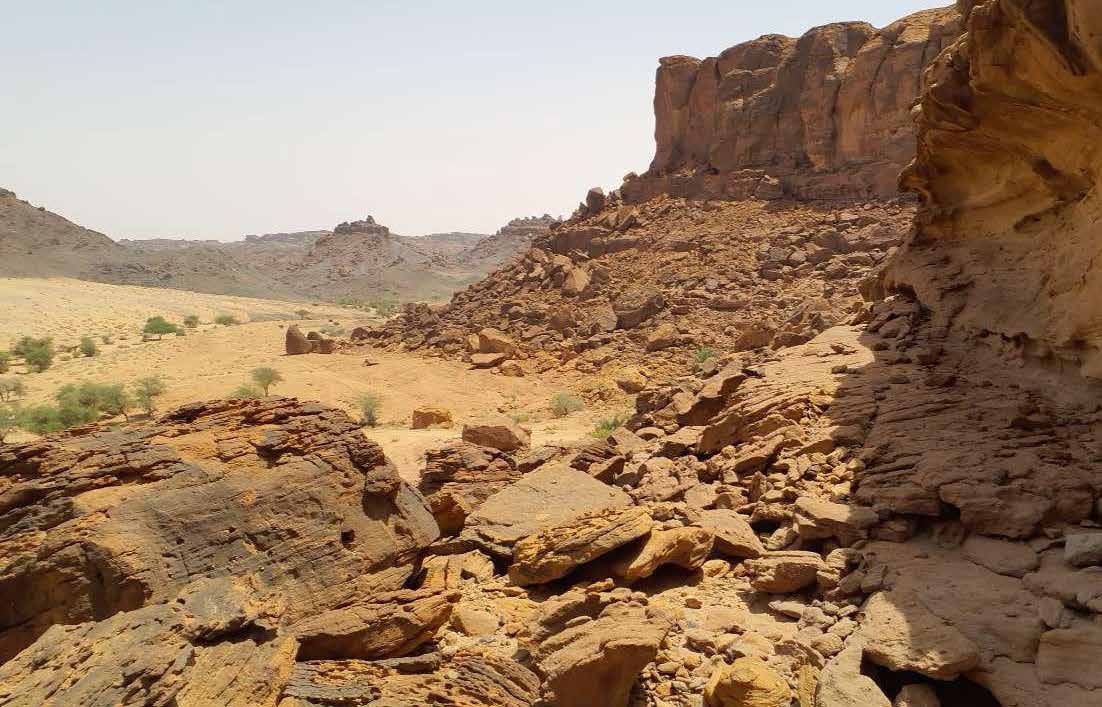
Sandstone boulder slopes and screes are erosion-dominated landforms that form on or below sandstone outcrops. These slopes are shaped by the breakdown and collapse of sandstone boulders, producing accumulations of coarse debris. Large boulders and irregular sandstone fragments create a mosaic of shaded pockets, sheltered voids, and small microterraces that retain moisture and fine sediments.
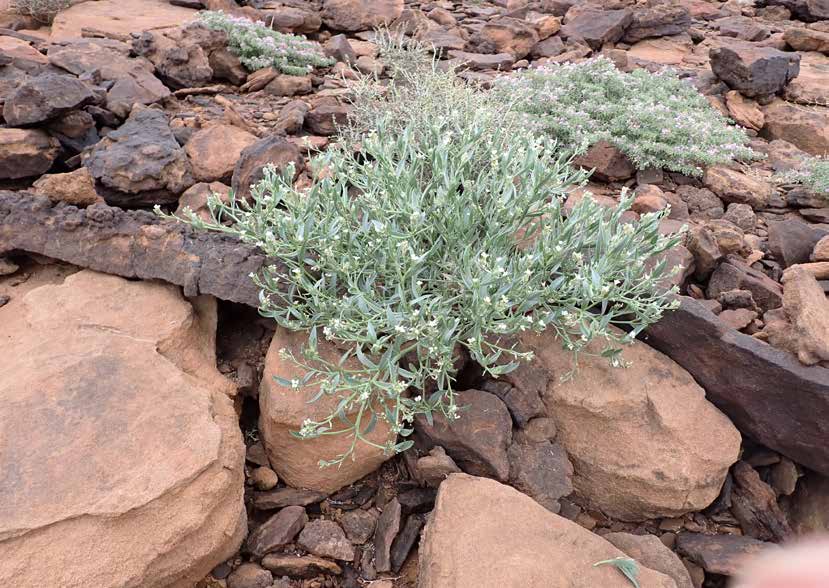
Very sparse mixed dwarf shrub vegetation.
Commonly with the shrub Ephedra ciliata and dwarf shrubs Anvillea garcinii, Iphiona scabra, Helianthemum lippii and Farsetia spp. In places this develops into a very open woodland dominated by scattered trees of Vachellia tortilis subsp. tortilis and Vachellia tortilis subsp. raddiana and the tussock grass Panicum turgidum becoming transitional with sandy wadis and plains.
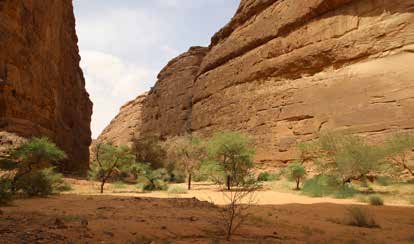
Sandstone Canyons
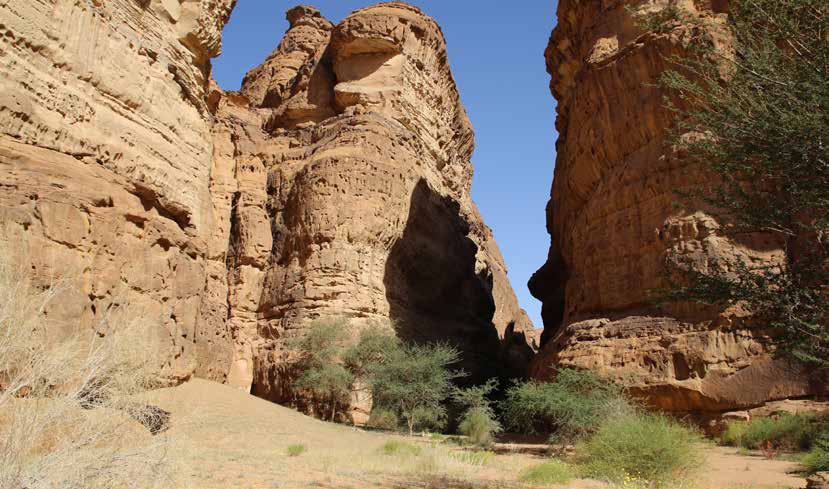
Sandstone canyons are deeply incised, narrow wadi systems cut into sandstone landforms. They are characterised by steep to near-vertical rock walls, confined valley floors, and strong contrasts between exposed, sunlit slopes and shaded, sheltered canyon interiors.
Also included here are sandstone gullies which represent smaller-scale incisions that dissect sandstone slopes and canyon walls. These share many structural and ecological characteristics but lack extensive canyon floors or developed riparian vegetation.
Typically dominated by species such as Retama raetam and Ochradenus baccatus and Vachellia gerrardi var. najdensis with Ficus spp. in wetter areas.
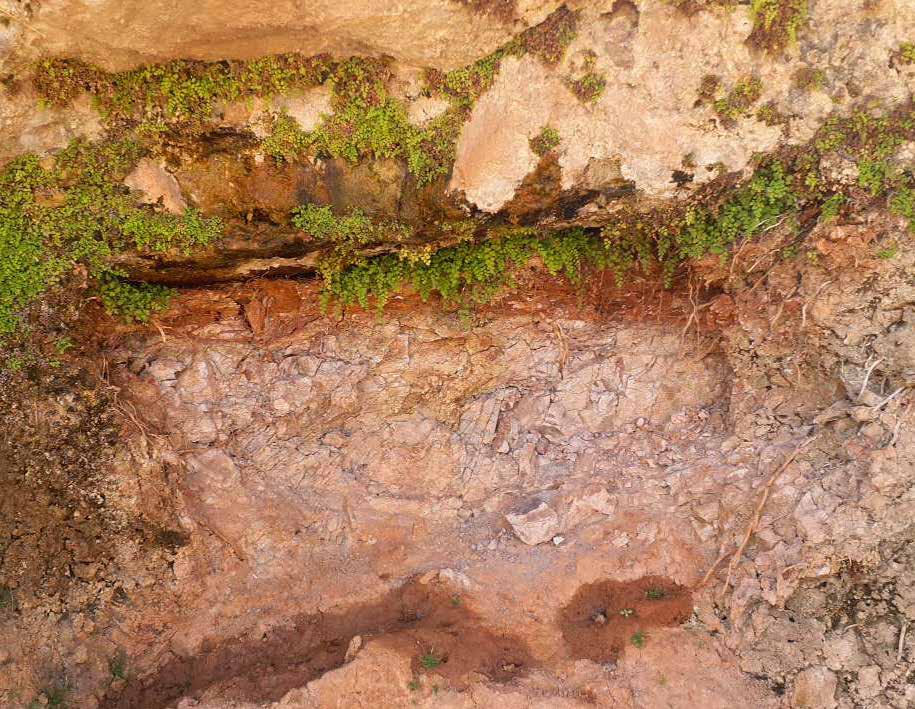
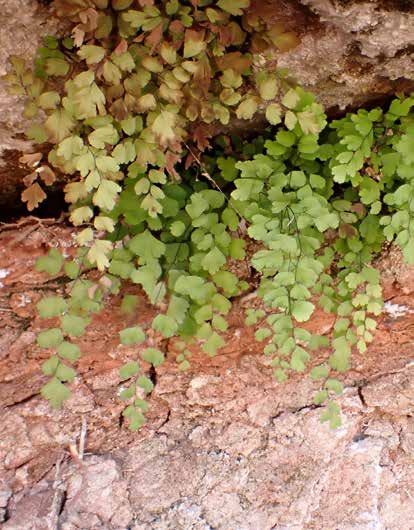
Seepage micro-habitat
Sandstone seepages are highly localised microhabitats formed where groundwater emerges slowly along sandstone fractures, bedding planes, or rock faces. They occur mainly in shaded cliffs, ledges, boulder slopes, and canyon walls, creating persistent moist microsites within otherwise arid areas. Although limited in extent, seepages support distinctive moisture-dependent vegetation and act as important ecological refugia.
Adapted from The Habitats of AlUla – Technical Manual (AFALULA, 2026).