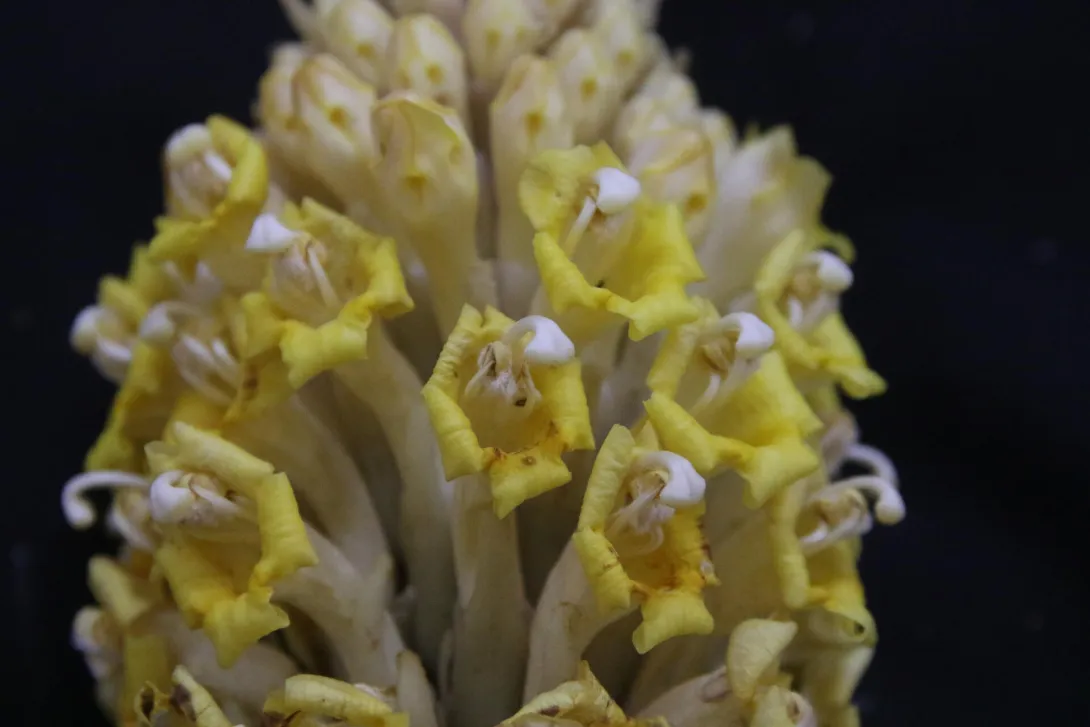
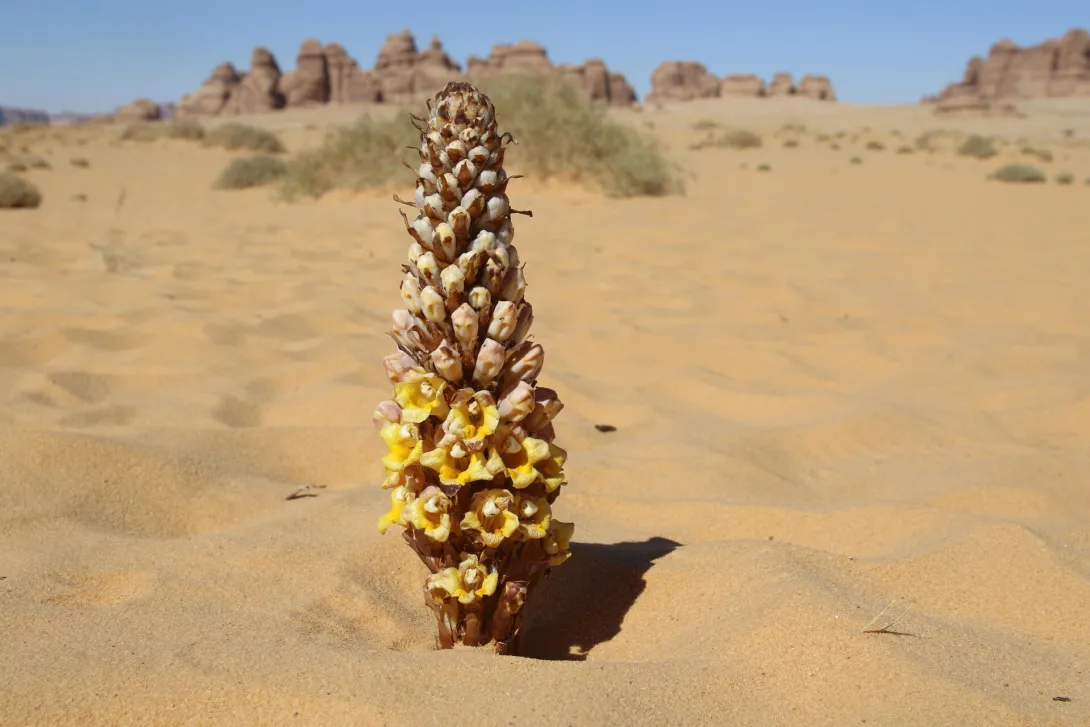
Cistanche tubulosa (Schenk) Wight ex Hook.f.
باصول، ذانون، زانون
Syn. Phelypaea tubulosa Schenk
Desert Cistanche, Desert Hyacinth, Desert Broomrape
Orobanchaceae
1 / 4

-
Morphological Description
-
Description
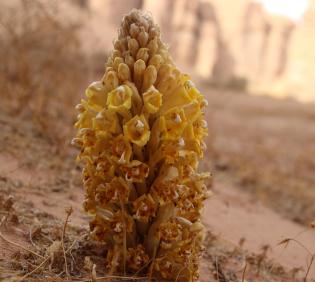
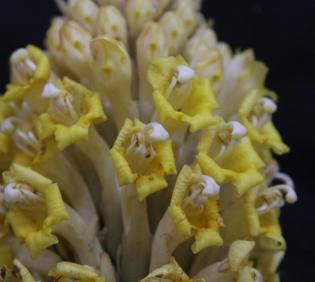
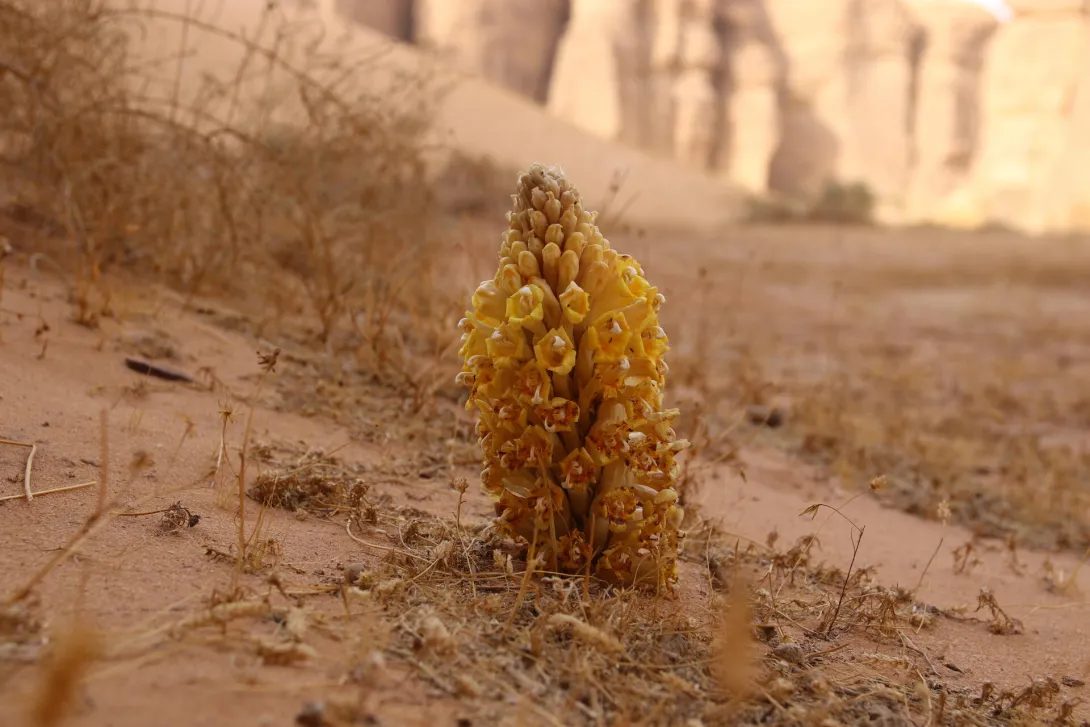
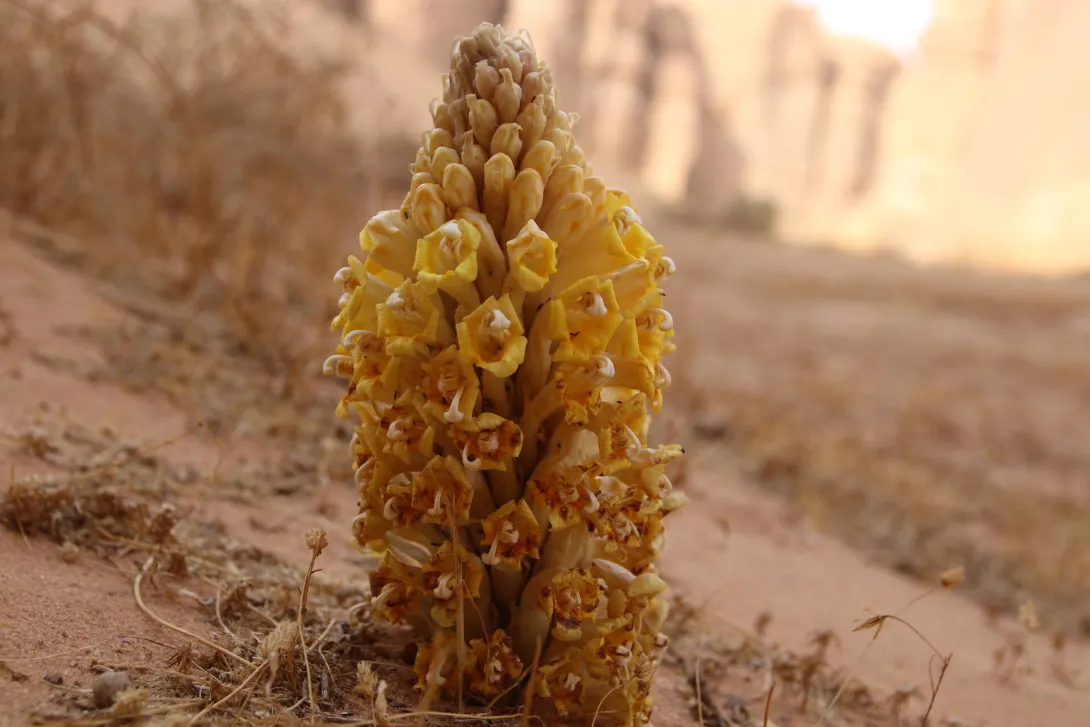
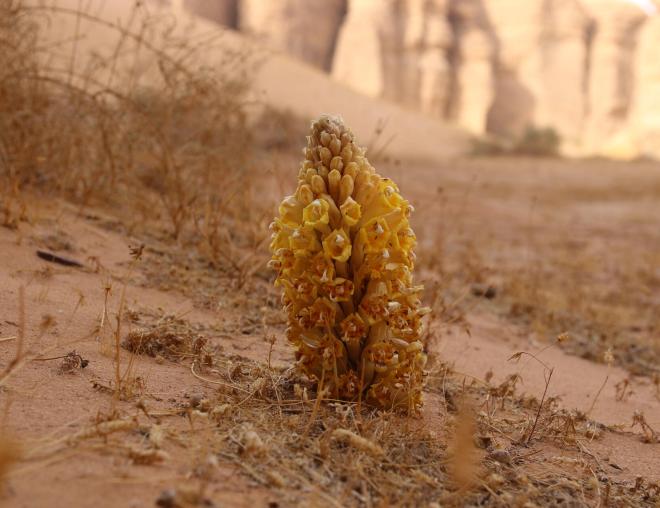
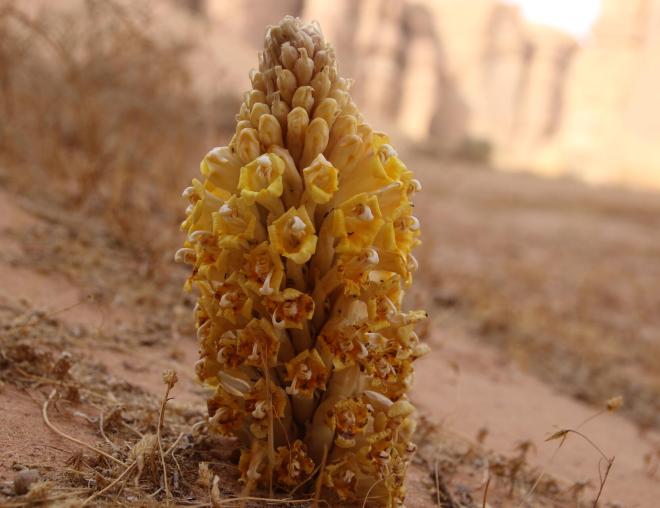
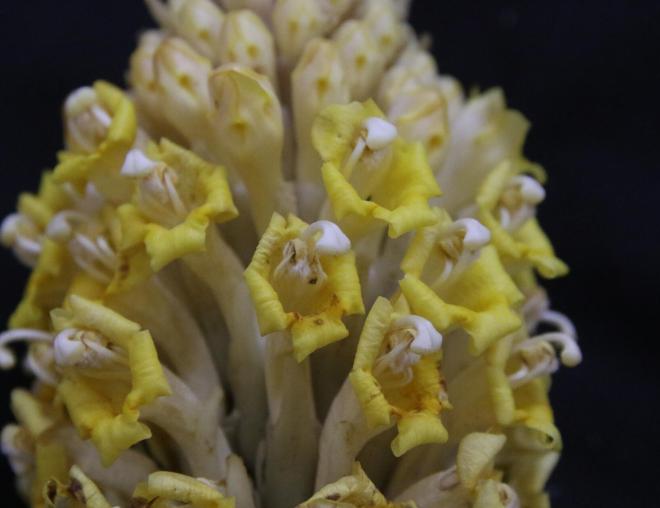
Leafless succulent perennial root parasite with unbranched stems measuring 20 cm up to 1 meter with a stem measuring 3 cm or wider. Flowers are organised in a a spike that emerge directly from the sand in early spring. Its conical shape enables it to break out of the ground upwards. The inflorescence lengthens, and the flowering advances from the bottom upwards, with all flowering stage on the same spike. The showy flower are yellow all over measuring up to 4 cm made up of a long tube, which opens into five rounded teeth. The bracts are irregulary crenualte, ranging creamy-white to purple. Calyx campanulate with obtuses lobes, crenulate and the large corolla measures up to 20 mm, 5-lobed, sub-labiate with a curved tube. Stamens are included with wolly-hairy anthers. The fruit is a capsule with numerous tiny alveolate seeds and dried plant can remain several years standing. In early spring, a fleshy and dense inflorescence emerges from the ground, which is made up of imbricate buds.
- Growth Form
-
Description
-
Habitat and Distribution
- Habitat
-
Geographical Distribution Range
This Irano-Turanian and Saharo-Arabian species is distributed across Sahara, Middle East and Indian subcontinent, including Cape Verde, Mali, Libya, Egypt, Sinai, Jordan, Lebanon, Syria, Iraq, Iran, Turkmenistan, Afghanistan, Kazakhstan, Pakistan, and until India. Within the Arabian Peninsula, it is native to Jordan, Saudi Arabia, Kuwait, Gulf States, Oman, Yemen, and Socotra.
-
Ecology
-
Phenology
JanFebMarAprMayJunJulAugSepOctNovDecFloweringFructification
- Origin
-
IUCN Red List Category
 Not Evaluated
-
Remarks
Around the world the species is common in all the Middle Eastern deserts, and westwards as far as Libya, southwards along East Africa, and eastwards as far as NW India and Turkmenistan. In the Sahara and western Mediterranean it is replaced by the similar and closely related Cistanche phelypaea (L.) Cout. Desert Cistanche is an holoparasitic species that is not capable of photosynthesis and obtains all nutrients and water from a host plant. Emerging after rains, parasiting several species such as Haloxylon, Tamarix, Ochradanus and Atriplex.
-
Phenology
-
Uses and Values
-
Aromatic and Medicinal Use
Medicinal use
-
Other Usages
Palatable
-
Description of Traditional Uses
The fleshy stems are harvested and used traditionally as a tonic, for treating gastrointestinal disorders, and for promoting vitality. It is often consumed as a food source in certain arid-land cultures.
-
Aromatic and Medicinal Use
Gallery