AlUla County
The Environment of AlUla
- 1 billion years of geology
- 20–30 mm of rain a year
- 41 °C summer days
- 460 plant taxa recorded
AlUla County, in northwestern Saudi Arabia, is a hyper-arid land where nearly one billion years of geology lie exposed: ancient mountains, carved sandstones, sand plains and dunes, and vast basalt lava fields. These contrasting landscapes shape the habitats and the plants that survive in them.
Climate
AlUla has a hot desert climate, typical of much of Saudi Arabia: very hot summers, mild winters, extremely low humidity and very little rain. From June to September, daytime temperatures commonly reach 41 °C, with nights around 24 °C. Winters are mild, with daytime highs up to 23 °C, while nights can fall below 4 °C. Higher areas are cooler.
Rainfall averages only 20–30 mm per year, mostly in short episodes in winter and early spring. Rare, intense storms can make the wadis flow and cause local flooding; over time these events have shaped the landscape and where people settled. Plants here must cope with long droughts, and many annuals appear only in the weeks after rain.
Geology
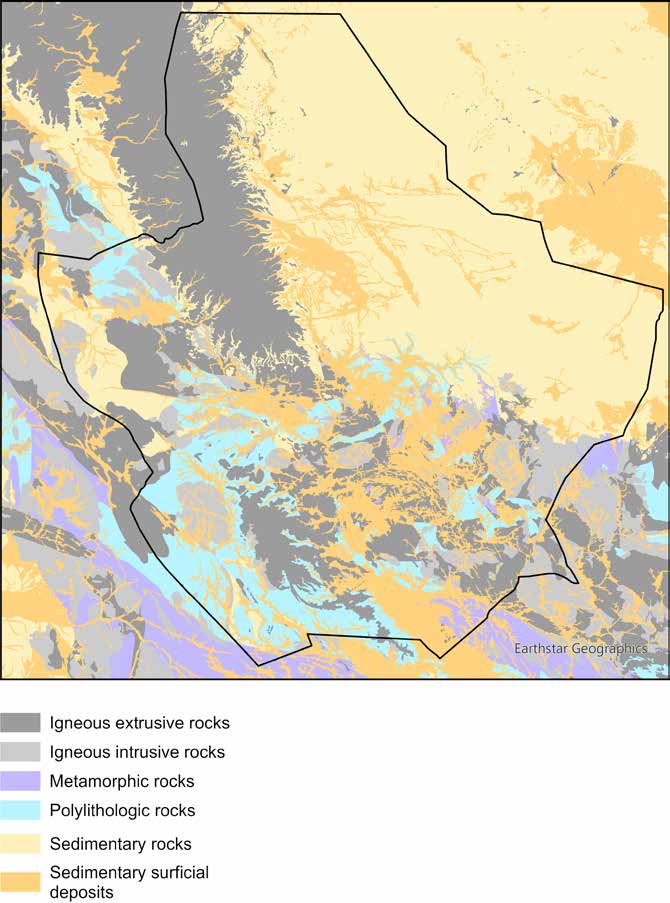
AlUla's landscape records a geological history spanning nearly one billion years, with a great variety of igneous, metamorphic and sedimentary rocks exposed over a relatively small area. In the hyper-arid climate this geology lies bare, and it is the main reason for the diversity of habitats.
The oldest rocks, Late Precambrian igneous and metamorphic complexes of the Arabian Shield, form the jagged mountains of the south, surrounded by gravel and sandy plains. They are overlain by Cambrian and Ordovician sandstones: the red, well-cemented Siq Sandstone, the lighter Quweria Sandstone and the softer Saq Sandstone. Wind and water have eroded these sandstones into outcrops, canyons, arches and sandy wadis, especially in the north.
More recently, from about 10 million to 500,000 years ago, basalt lava flows linked to the opening of the Red Sea covered the sandstones in several places, creating vast plateaus known as harrats. The largest is Harrat Uwayrid, now a Biosphere Reserve, where volcanic cones can still be seen. Throughout the region, valleys are filled with alluvium ranging from water-worn boulders to fine wind-blown sand.
Flora and Vegetation
AlUla lies within the deserts and xeric shrublands biome, at the meeting point of several ecoregions, and roughly midway between two global biodiversity hotspots: the Mediterranean basin and the Horn of Africa. Its flora mixes widespread desert plants with regionally restricted species and elements of Mediterranean, Irano-Turanian and Sudanian origin.
460 vascular plant taxa have been recorded, across 65 families and 277 genera: about 20% of the flora of Saudi Arabia. Seven species are endemic to the Kingdom and three to the Arabian Peninsula, among them Euryops jaberiana and Nepeta sheilae. More than 70 species are range-restricted, found only in northwestern Saudi Arabia and neighbouring countries such as Jordan and Egypt. Most species have not yet been assessed for the IUCN Red List, and threatened plants such as Thymbra nabateorum show both the importance of AlUla for plant conservation and the potential for new discoveries.
The vegetation is mostly open and sparse, and its composition follows the habitats. Acacias such as Vachellia tortilis and Vachellia gerrardi line the wadis; Haloxylon salicornicum and Stipagrostis grasses cover the sandy plains; Retama raetam, Ochradenus baccatus and wild figs shelter in sandstone canyons; salt-tolerant plants grow in ephemeral flooded depressions; and date palms dominate the agricultural oases.
AlUla is also surprisingly rich in bryophytes and lichens, with 48 bryophyte species and more than 100 lichens recorded in the AlUla–Khaybar region. They live mainly in shaded canyons, seepages, springs and runoff channels, and in the biological soil crusts that stabilise the desert surface. The region also supports a rich fauna of 622 recorded taxa, including the Sooty falcon, of which about 2% of the world population nests in AlUla.
Environmental Degradation
Overgrazing, woodcutting, off-road driving and climate change put growing pressure on AlUla's fragile desert habitats, which can take decades to recover. People have lived in AlUla for millennia. For centuries, nomadic and semi-nomadic herders moved their flocks with the rains and regulated access to pastures, keeping a balance between livestock and natural resources. Much of the vegetation is therefore a cultural landscape rather than a strictly natural one.
In recent decades, pressures have grown well beyond what many habitats can absorb. Around 70% of Saudi Arabia's rangelands are considered moderately to extremely degraded. In AlUla, overgrazing by domestic livestock is the main driver: it reduces plant diversity and cover, prevents young plants from establishing, compacts and erodes the soil, and favours unpalatable species. Woodcutting, now mostly for camping fires, removes trees and shrubs. Off-road driving damages plants and soil surfaces that may take decades to recover, which is why the Royal Commission for AlUla has prohibited driving that harms vegetation. Abandoned farmland and climate change, with hotter temperatures and more extreme droughts and storms, add further pressure.
Degradation can be read in the field: low plant cover, browsed shrubs, trees with no young plants around them, cut stumps and vehicle tracks. Some plants are useful indicators. Decreasers, palatable species such as Panicum turgidum, Rhanterium epapposum, Calligonum comosum and Stipagrostis grasses, decline under heavy grazing. Increasers, unpalatable or grazing-tolerant species such as Calotropis procera, Rhazya stricta, Citrullus colocynthis and Asphodelus tenuifolius, become more abundant.
Adapted from The Habitats of AlUla – Technical Manual (AFALULA, 2026), chapter 2.